
Introduction
If your dog explodes into barking whenever another dog appears on a walk, you are dealing with a common but frustrating behavior. Learning how to stop a dog from barking at other dogs on leash starts with understanding why the reaction happens rather than simply trying to silence it.
Leash barking can come from fear, frustration, excitement, anxiety, or a desire to make another dog move away. A dog may bark because it wants to greet the other dog, or because being restrained prevents it from escaping an uncomfortable situation. These different motivations can look surprisingly similar from the outside.
The good news is that leash reactivity can often be improved with thoughtful management and behavior modification. The goal is not simply to stop the noise. You want your dog to notice another dog, remain emotionally under control, and choose a calmer response.
This guide explains a practical reactivity protocol based on distance, desensitization, counterconditioning, and reinforcement of alternative behaviors.
What Is Leash Reactivity in Dogs?
Leash reactivity describes an exaggerated emotional response to something a dog encounters while restrained. The trigger might be another dog, a person, a bicycle, or a vehicle.
A reactive dog may bark, growl, lunge, pull hard, freeze, whine, or become intensely focused on the trigger. Reactivity does not automatically mean a dog intends to attack. Some dogs react because they are frightened, while others become frustrated because the leash prevents them from approaching.


This distinction matters because the training plan should address the emotion behind the behavior. A dog that wants distance may need confidence-building and carefully controlled exposure. A dog that desperately wants to greet other dogs may need impulse control and alternative ways to handle frustration.
Why Does My Dog Bark at Other Dogs on Leash?
Before asking how to stop a dog from barking at other dogs on leash, consider what your dog is trying to accomplish.
Fear or Anxiety
A fearful dog may bark because another dog feels threatening. Barking can create distance. If the other dog eventually walks away, your dog may learn that barking worked.
Frustrated Greeting
Some dogs are perfectly comfortable around other dogs but become frantic when they cannot reach them. The leash creates a physical barrier, which can produce barking, pulling, whining, and lunging.
Overexcitement
Some dogs become so excited by the sight of another dog that they lose their ability to respond calmly. Their behavior can resemble aggression even when the underlying emotion is excitement.
Previous Negative Experiences
A frightening encounter with another dog can change how a dog responds during future walks. Even one unpleasant experience may make certain dogs more vigilant.
Lack of Appropriate Social Experience
Some dogs simply have not learned how to remain calm around unfamiliar dogs. Socialization does not mean forcing dogs to greet everyone. It means helping them develop comfortable, appropriate responses to different situations.
Understand Your Dog’s Threshold
The most important concept in a reactivity protocol is the threshold.
Your dog’s threshold is the point at which the trigger becomes so intense that your dog can no longer respond calmly or learn effectively. For one dog, another dog may be manageable at 50 feet. Another dog might remain calm at 15 feet.
Below threshold, your dog may notice another dog while still being able to eat, look at you, walk, or respond to a familiar cue. Above threshold, barking and lunging may take over.
Effective desensitization starts below this threshold rather than deliberately putting the dog into a full reaction. AKC recommends beginning far enough away that the dog notices the trigger without reacting, then gradually reducing the distance.
The Reactivity Protocol: How to Stop a Dog from Barking at Other Dogs on Leash
Step 1: Prevent Unnecessary Reactions
Training becomes much harder when your dog repeatedly rehearses barking and lunging.
For a period of time, choose quieter walking routes or less busy hours. Cross the street when necessary. Use parked cars, trees, or other visual barriers to create distance.
Management is not a failure of training. The American Veterinary Society of Animal Behavior recommends management alongside behavior modification for fearful and reactive dogs because preventing overwhelming encounters helps protect the training process.
Your immediate goal is to give your dog fewer opportunities to practice the unwanted response.
Step 2: Teach an Emergency U-Turn
Before working around other dogs, teach your dog that turning with you is rewarding.
Practice in a quiet location. Say a consistent cue such as “this way,” turn around, and encourage your dog to follow. Reward your dog when they come with you.
Gradually practice the maneuver in more distracting environments.
When another dog suddenly appears too close, an emergency U-turn gives you a practical way to increase distance before your dog crosses the threshold. AKC also recommends teaching proactive avoidance skills such as an emergency turn and moving behind the handler.
Step 3: Find the Starting Distance
Now identify how far away another dog needs to be for your dog to remain relatively calm.
Do not start by walking directly toward another dog.
Instead, find a distance where your dog notices the other dog but can still take food and respond to you. That might be across a wide field, down the sidewalk, or on the opposite side of a street.
This distance becomes your starting point.
Step 4: Pair the Other Dog With Something Valuable
This is the heart of counterconditioning.
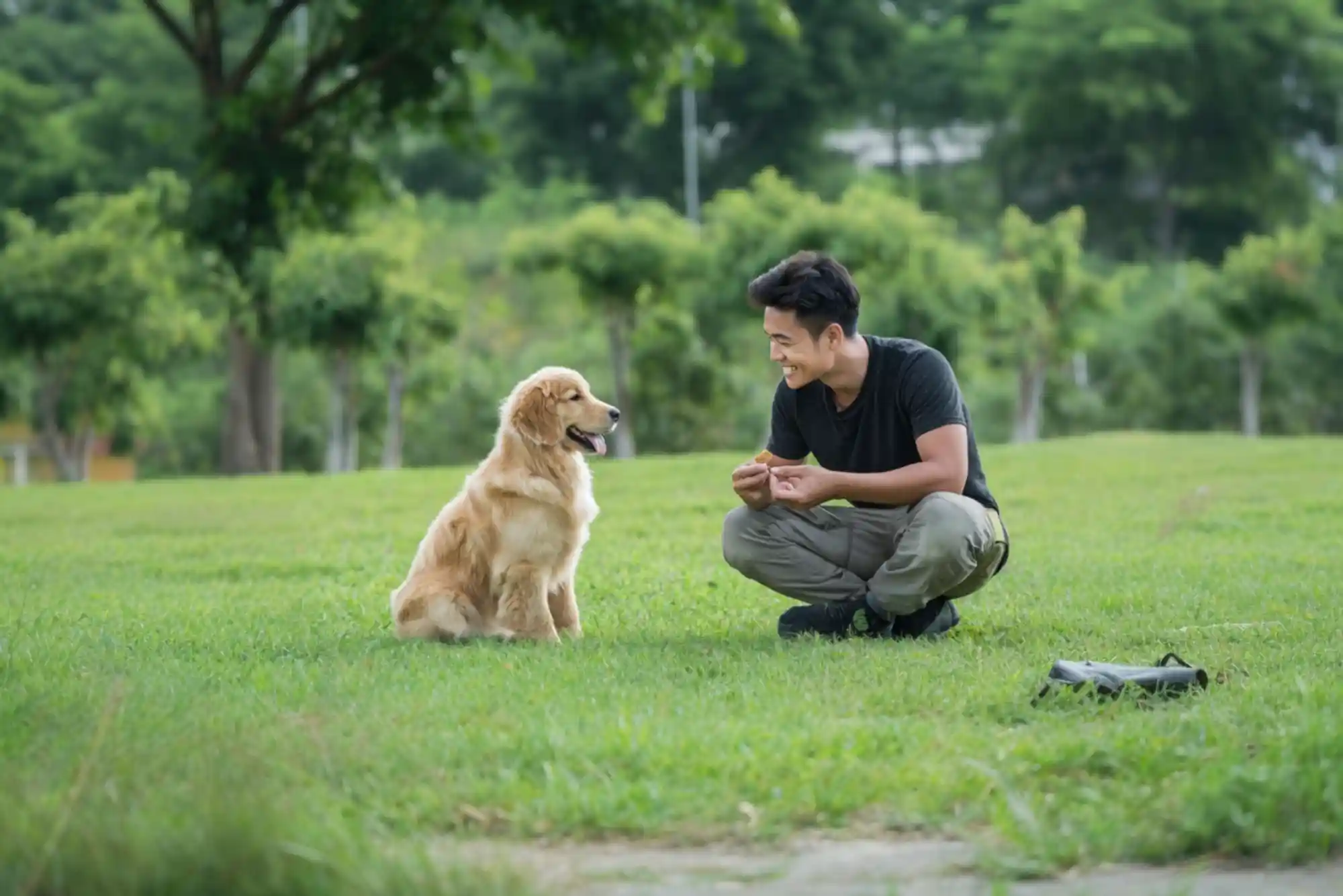
The moment your dog notices another dog, provide a high-value reward. Chicken, cheese, a favorite treat, or another reward your dog genuinely loves can work.
The sequence should be simple: your dog sees another dog, and something wonderful happens.
Continue rewarding while the trigger remains visible. When the other dog disappears, the rewards stop.
Over repeated sessions, the emotional association can change. Instead of immediately thinking, “I need to react,” your dog can begin learning, “Another dog appears, and good things happen.”
AKC describes this approach as desensitization and counterconditioning, with the dog kept below threshold while the trigger is paired with valuable rewards.
Step 5: Reward Calm Observation
Do not wait for your dog to stare at another dog for several seconds.
Reward small moments of calm.
Your dog looks at the other dog and remains quiet. Reward.
Your dog looks back toward you. Reward again.
Your dog notices the trigger and then continues walking. Reward that choice.
You are teaching your dog that calm behavior around another dog is valuable.
Over time, your dog may begin looking at the trigger and then automatically turning back toward you. That response is exactly what you want to build.
Step 6: Teach an Alternative Behavior
Once your dog understands that calm behavior around other dogs earns rewards, introduce a simple replacement behavior.
“Look at me,” “touch,” “let’s go,” or walking beside you can all be useful.
Practice the behavior away from triggers first. Your dog needs to understand the cue before you expect them to perform it around another dog.
AKC similarly recommends building attention and alternative behaviors in low-distraction environments before gradually adding more challenging distractions.
Step 7: Reduce Distance Very Gradually
Once your dog can repeatedly remain calm at the starting distance, reduce the distance slightly.
Do not make large jumps.
If your dog was successful at 50 feet, moving to 45 feet may be more appropriate than suddenly moving to 20 feet.
Continue pairing the sight of another dog with rewards.
If your dog starts barking, lunging, freezing, or refusing food, consider that information rather than failure. You may have moved too close or increased difficulty too quickly.
Move farther away and allow your dog to settle before trying again.
What to Do When Your Dog Starts Barking
Even with careful planning, reactions will happen.
If your dog suddenly starts barking at another dog, avoid yelling, leash jerking, or repeatedly demanding obedience.
Instead, create distance.
Use your practiced U-turn. Move behind a visual barrier if possible. Walk away until your dog can think again.
Once your dog has recovered, you can continue the walk or end the training session.
The important point is that you should not intentionally keep your dog close to the trigger while they are already overwhelmed. Desensitization works by controlling intensity, not by flooding the dog with exposure.
Should You Correct a Dog for Barking at Other Dogs?
Punishing the barking may suppress the visible behavior without changing the underlying emotion.
If a dog is frightened, adding pain or intimidation can make the presence of another dog even more unpleasant. If the dog is frustrated or overexcited, punishment does not necessarily teach what the dog should do instead.
A reward-based approach gives the dog a clear alternative.
Instead of focusing entirely on “don’t bark,” teach your dog what to do when another dog appears: look at you, move away, walk calmly, or stay engaged with you.
The objective is emotional and behavioral change, not simply silence.
Equipment Can Make Training Easier
Training equipment should help you maintain control without creating unnecessary discomfort.
A secure, properly fitted harness can be useful for many dogs, particularly when the dog has a history of pulling or lunging.
Use a leash that gives you enough control without encouraging constant tension. Keep safety as the priority, especially around unfamiliar dogs.
Equipment alone will not resolve reactivity. It simply gives you a safer framework in which to apply the behavior plan.
Common Mistakes That Slow Progress
One common mistake is getting too close too quickly.
Owners naturally want to know whether the dog can “handle” another dog. However, deliberately testing the dog at close range can trigger another reaction and make future sessions harder.
Another mistake is waiting until the barking begins before offering guidance. The best time to intervene is when your dog first notices the trigger and is still capable of making choices.
Inconsistent walks can also slow progress. If the dog sometimes gets rewarded for calmly watching another dog but other times is allowed to charge toward the trigger, the training picture becomes less predictable.
Finally, avoid measuring success only by distance. A dog that can remain calm at 20 feet today may have a difficult day tomorrow. Progress is not always linear.
How Long Does Leash Reactivity Training Take?
There is no universal timeline.
Some dogs show noticeable changes within several weeks of consistent training. Others need months of gradual work, particularly when fear or severe arousal is involved.
Progress depends on the dog’s history, environment, trigger intensity, training consistency, and ability to remain below threshold.
The goal should be steady improvement rather than a specific deadline.
A calm response from 30 feet away is meaningful progress if your dog previously reacted at 50 feet.
When Should You Work With a Professional?
Professional help is appropriate when your dog’s reactions are intense, unpredictable, difficult to manage, or creating a safety concern.
A qualified reward-based trainer can help identify triggers, establish an appropriate starting distance, and adjust the training plan.
A veterinary behaviorist may be particularly useful when fear, anxiety, aggression, or extreme arousal is involved. In some cases, veterinary professionals may consider whether medication could support behavior modification by reducing excessive arousal.
If your dog has bitten another dog or person, seek professional guidance rather than attempting close-contact training yourself.
Build Calm Responses One Walk at a Time
Learning how to stop a dog from barking at other dogs on leash is less about forcing your dog to be quiet and more about changing what happens when another dog appears.
Start with management. Find your dog’s threshold. Create distance before the reaction begins. Pair other dogs with valuable rewards, reinforce calm choices, and teach reliable alternative behaviors such as “look at me” and an emergency U-turn.
Most importantly, progress at your dog’s pace. A reactive dog does not need to greet every dog or become completely indifferent overnight. The practical goal is a dog that can notice another dog and remain capable of making a calm choice.
FAQs
How do I stop my dog from barking at other dogs while walking?
Start by identifying the distance at which your dog can see another dog without reacting. Keep your dog below that threshold, reward calm observation, and gradually decrease the distance over multiple sessions. Management, desensitization, and counterconditioning are commonly used for leash reactivity.
Why does my dog bark and lunge at other dogs on walks?
The behavior can have different causes, including fear, frustration, excitement, anxiety, or a desire to create distance. Leash restriction can intensify the response because the dog cannot freely approach or move away.
How do I train my dog to ignore other dogs?
Begin at a distance where your dog can notice another dog without reacting. Reward your dog for looking calmly and then returning attention to you. Gradually work closer only when your dog remains comfortable.
Should I let my leash-reactive dog greet other dogs?
Not necessarily. On-leash greetings are not required for healthy social behavior, and unpredictable greetings can make training more difficult. Teaching your dog to calmly pass other dogs can be a more useful walking skill.
Can a leash-reactive dog be cured?
Many dogs can improve substantially with appropriate management and behavior modification, but there is no guaranteed timeline or single treatment that works for every dog. The realistic goal is to build calmer, safer responses and reduce the frequency and intensity of reactions.
Is leash reactivity the same as aggression?
No. Reactivity describes an exaggerated response, while aggression involves behavior intended to threaten, intimidate, injure, or control another individual. A reactive dog may bark or lunge without intending to attack.